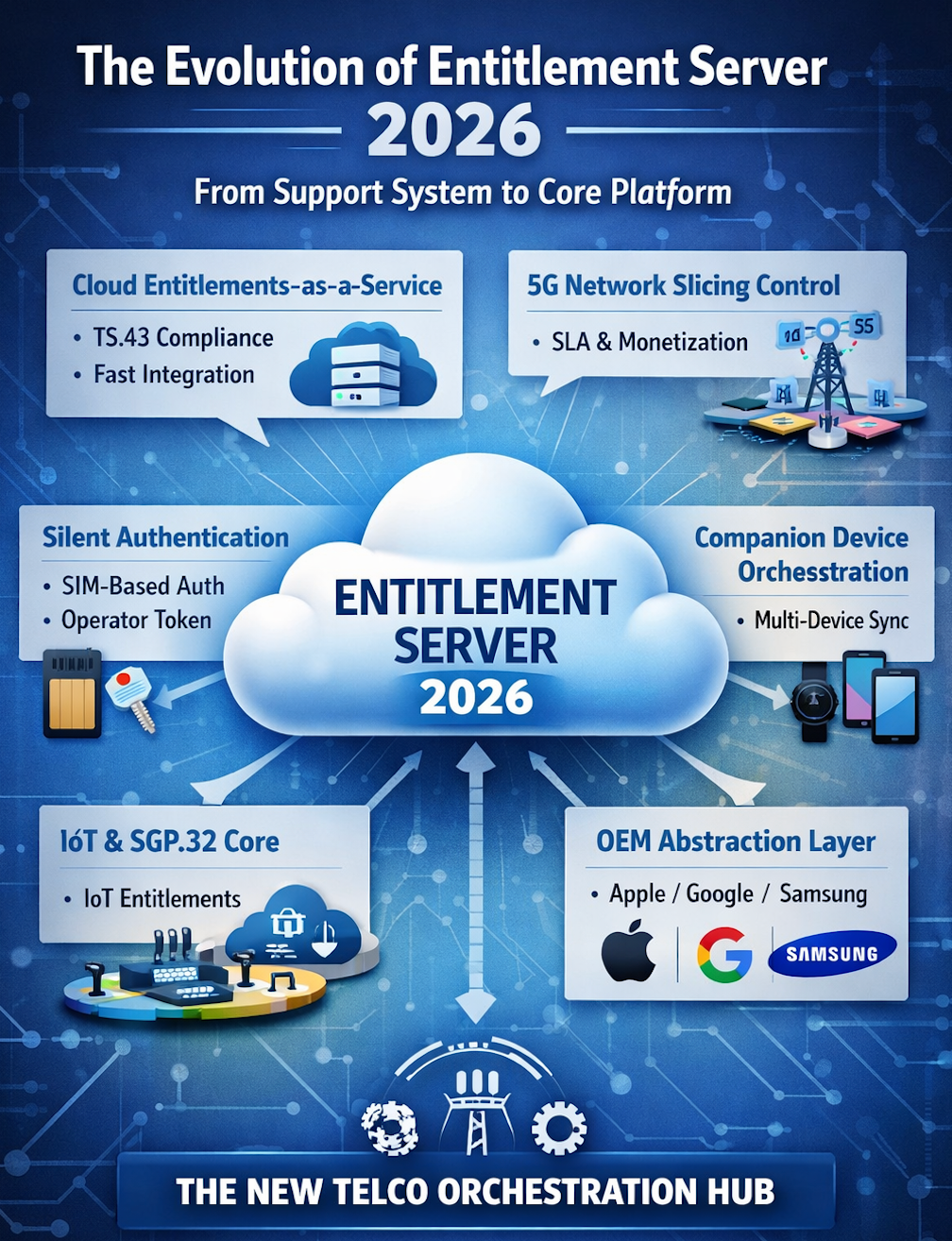
The Entitlement Server was originally built as an integration layer — a system that handled device configuration requests, checked subscription state, and returned allow/deny decisions. That role is being eclipsed by a much larger one.
By 2026, the Entitlement Server is becoming the central orchestration platform of the modern telco. This is not a product roadmap aspiration — it is driven by three structural forces already in motion.
Force 1: 5G SA and Network Slicing
5G Standalone architecture introduces network slicing — the ability to carve logically isolated network instances with dedicated SLAs for latency, throughput, and reliability. Someone has to decide which subscribers can access which slices, enforce SLA boundaries, and monetise slice usage. The Entitlement Server is the natural home for slice eligibility decisions, enforcement, and commercial rules. No other system in the telco stack is positioned to do this at the required speed and granularity.
Force 2: Multi-Device Complexity
The average subscriber no longer has one device — they have three or four:
- Smartphone
- Tablet
- Smartwatch
- Connected car
- Home broadband
Each device has distinct capabilities, plan entitlements, and usage patterns. Per-device provisioning at this scale produces inconsistent user experiences and unsustainable operational complexity. The ES must evolve to deliver cross-device entitlement policy from a single, consistent rule set — not per-device provisioning one device at a time.
Force 3: The API Economy and Open Gateway
GSMA Open Gateway exposes standardised telco network APIs to third-party developers. SIM-based silent authentication — where the network verifies user identity without an SMS OTP — is one of the most valuable capabilities on offer. The ES is the trusted identity layer that makes this possible. Without a mature, reliable ES, silent authentication is not deliverable. The API economy monetisation opportunity is gated on ES capability.
The Architectural Shift
Taken together, these three forces produce a clear conclusion: the Entitlement Server is moving from the edge of the telco architecture to the centre. The shift is not incremental — it is architectural. The ES becomes simultaneously:
- a policy engine
- an identity layer
- a business orchestrator
Operators that treat the ES as a legacy configuration system will find themselves unable to deliver the 5G and API economy capabilities their enterprise and consumer customers expect.