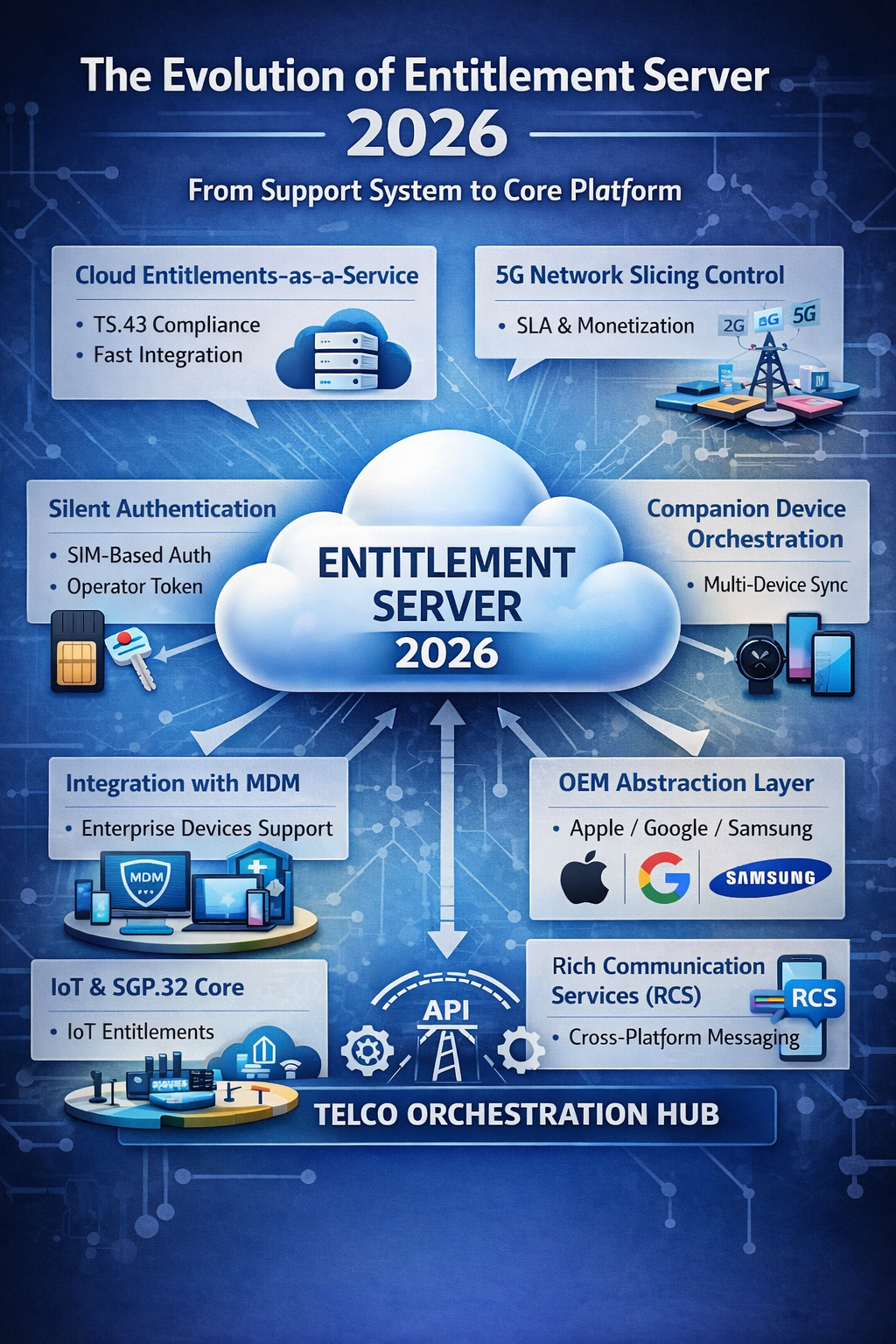
The modern Entitlement Server (ES) is no longer defined solely by the vertical domains it manages. Its decisive value in 2026 comes from a set of horizontal capabilities that address service fragmentation and ecosystem volatility directly. Rather than distributing that complexity across messaging platforms, identity providers, and device-specific backends, operators consolidate these functions inside the ES as a stabilising abstraction layer. Two pressures make this consolidation non-optional:
- Service fragmentation across messaging, identity, and device features
- Ecosystem volatility driven by OEM behaviours and rapid innovation cycles
RCS & Digital Messaging Enablement
Rich Communication Services is the cross-platform evolution of messaging — replacing SMS and competing directly with OTT applications. The ES is the system positioned to govern access to it. Its role spans the full lifecycle:
- Eligibility decisions — determining user access based on subscription state and device capability
- Credential provisioning — issuing RCS credentials through secure, device-based activation
- Enterprise messaging — enabling business messaging with the compliance controls enterprises require
- API exposure — surfacing RCS functionality to digital partners through standardised APIs
Market momentum is real, not speculative: Google, Apple (RCS support landed in iOS 18), and the major operators are all driving adoption. The ES is where commercial and technical eligibility for that traffic is resolved.
OEM Abstraction Layer
Device vendors continually introduce proprietary extensions that would otherwise force backend adaptation with every release. The ES absorbs that churn:
- Shields backend systems from vendor-specific requirements
- Accelerates capability rollout without backend modifications
- Creates a single integration point for all OEMs
Concrete example: Apple introduces a new eSIM activation flow in iOS 26. The ES adapts to the new flow while presenting a consistent interface to BSS — no BSS changes required. The volatility is contained at the abstraction layer, exactly where it belongs.
ES vs. the Alternatives
It is fair to ask why the ES — rather than an adjacent system — should own these responsibilities. The alternatives each fall short on a structural axis:
- BSS middleware platforms lack real-time decision capability and device awareness; the ES delivers sub-second responses with full device context.
- Policy engines (PCF, PCRF) remain network-centric — no business logic, no identity integration.
- Cloud-native orchestrators lack standardised device protocols and the operator-specific consistency telco workflows depend on.
- Identity providers (Auth0, Okta, Entra ID) lack telco context and 5G network integration entirely.
The ES Differentiator
The Entitlement Server is the only system that combines all four prerequisites in a single decision path:
- device context
- network integration
- business logic
- standards-based interoperability
That combination is what makes the ES purpose-built for telecommunications orchestration — and why its horizontal capabilities consolidate into a stabilising layer rather than yet another point integration. As messaging, identity, and device ecosystems keep fragmenting, the operators that route this complexity through the ES will absorb change at a single, governed seam instead of across the entire stack.